
Everything We Knew and Loved

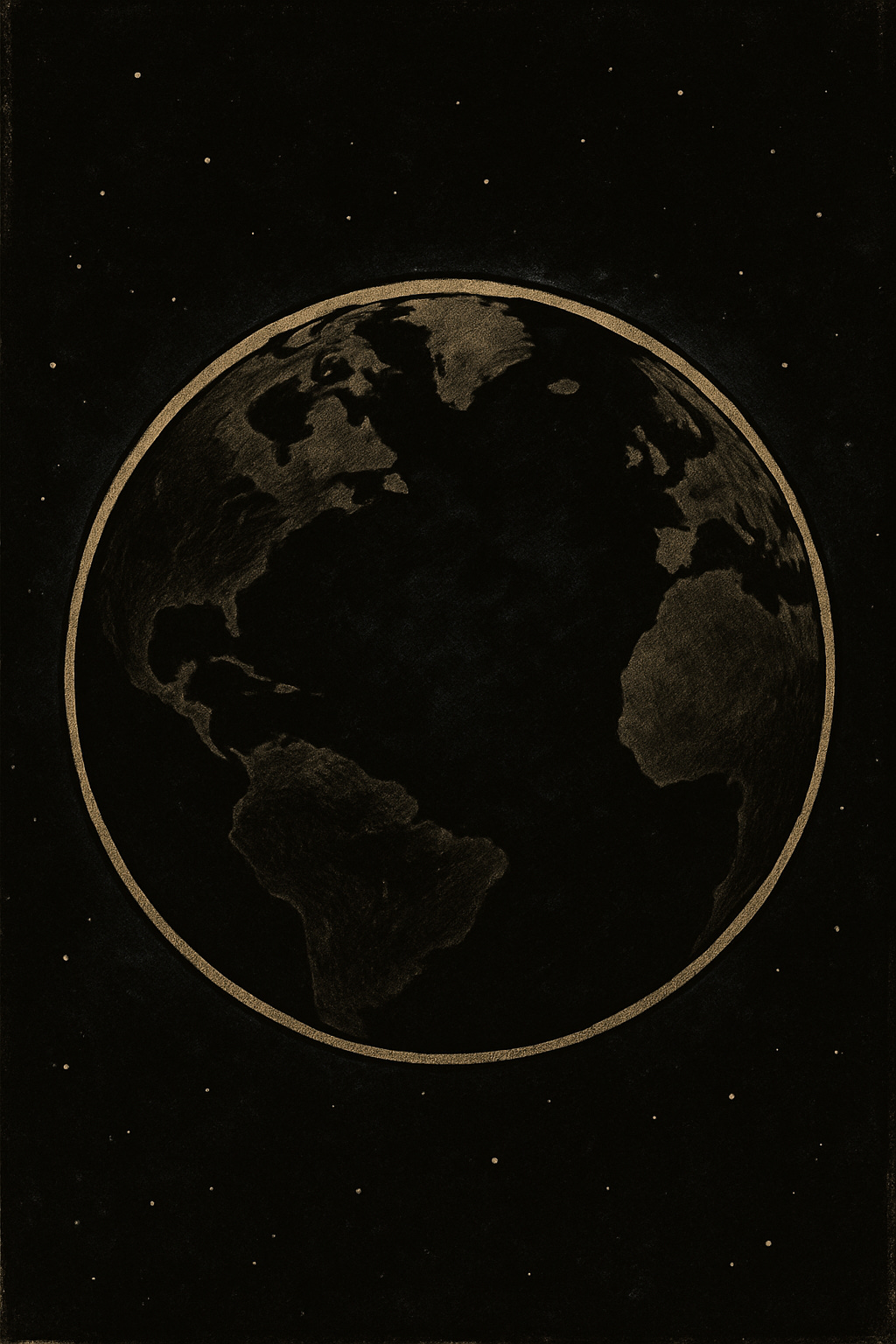
They came to us from the stars. The little pretty things. They stood about eighteen inches high, weighed three pounds at their heaviest, were soft as a lamb, fragrant as a morning lilac, and appeared so unquestionably, so sensuously, female humanoid. Their eyes sparkled, without pupils or irises, as they looked at you, a deep iridescent indigo. An ever-widening void of exotic promises.
“Sir?” A voice cut through Martin Patrick’s lewd recollection. He blinked, and the mist lifted.
“Yes?” Martin asked. A young man in a crisp gray uniform stood at attention in the doorway.
“Would you care for some water, or a bump, before you address the assembly?”
“No. No, thank you. That’s not necessary.” Martin waved his hand dismissively.
“Very good, sir. The uplink is ready and it will be a few moments yet,” said the young man. Martin shook his head gravely. The fog took him back. The young man took the hint and left.
We called them, “Inkies” when most everyone we knew had one. The nimble little sprites would dance on your shoulder, sing haunting melodies, play with your food, swim in your bath water, and if you were lucky, make pretty faces at you while you tried to meet a deadline. They seemed dependent on your attention, as if it was their primary source of nourishment; actually eating and drinking, but sparingly yet relentlessly contending for your constant consideration.
The only downside, at least perceptible at the time, was that they had to choose you. You couldn’t pop down to the shops and buy one, outbid a faceless neighbor online. You couldn’t catch one in the garden and bring it into your house. One day, the little creature would just show up; on a kitchen counter, a windowsill, on your nightstand when you reached for the snooze button—from that moment on, it would never leave your side. Or her. She. She would never leave your side. It adversely affected society after a year. People spent more time occupied with their Inkies than they did pushing buttons, pulling levers, patching leaks, calculating figures, processing requests, and then collecting harvests and flipping “on” switches. I’m only here today because I was never chosen.
“Sir?” Another voice broke Martin’s reflection.
“What is it?” Martin snapped.
“Washington has gone dark, sir,” another pert young grey-clad man informed.
Martin heard the deafening silence. His head felt as though it would tumble off his shoulders. He felt his fingers rubbing his cheek. The last “on” switch had gone unflipped. He had locked the door when he’d left his home, but now the key was lost.
“We are proceeding, sir?” The trim youth had an inquisitive exuberance that made Martin want to kick him in the mouth. No going back now, he thought.
“Yes,” Martin replied, “we are.”
My wife and I had only been married six months when her Inkie came along. The novelty of our bound flesh was just starting to feel natural. She had become my fern in the garden. First to sprout, the quiet feature, my secret favorite. Flowers bloom and die. Ferns return every year, fuller, farther, wider, deeper, and more grand with each unfurling. That all went to seed when the cobalt death touched its tiny feet down upon our butcher block countertops one sunny morning.
“Alexis”, the sapphire nymph, chose her, of course. She loved to feed it popped corn. The smacking sound it made with its little mouth brought her interminable delight. No matter how often I tried, Alexis would never take the popped corn, or any other treat, from me. It would scramble to hide behind my wife’s neck and peek out to watch me with those shimmering azure pits. I knew it was hate that simmered in the coruscate lapis, but I was still very much in love and didn’t dare smash it with a ball-peen hammer.
My wife avoided me to keep her Inkie in high spirits. To keep it dancing and nibbling and splashing in her bath water. Soon, I’d found I was wedded to a laugh that would carry down the hall several times a day. Banishment from my wife’s bed allowed me to spend more time with the other yet unselected world controllers, though they themselves soon became disembodied guffaws echoing down the corridors of Parliament. I, and a small handful of others, would have to make some drastic decisions if mankind were to survive.
“Sir?” Another stiff gray habit.
“What, damn you?” Martin slammed his fist on the desk.
“Apologies, sir. The captain wants you to know that the last of the transports has landed. and we are closing the doors. For good, sir.”
“That’s fine. I will be out to address everyone presently.”
She left me in the summer of 2065. Probably sooner. She’d left everything but that blue eddy that existed in Alexis’ eyes. I found the note when I went to tell her about The Leaving, that we would not be giving her a certificate of admittance and that I was, in fact, leaving her on Earth. Her and her stupid goddamn alien doll, and everyone else and their stupid goddamn alien dolls, were on their own now. The Inkies hadn’t chosen us, so we had chosen not to save them, or the ones they had chosen. They would die along with the rest, malnourished, ill-kept, disease-ridden, and perpetually enraptured.
Martin Patrick’s smart, black-wrapped figure walked down the halls of the brutal complex on the Moon. The air smelled of sharp electricity. Perfect ozone. He entered a vast hall, stepped into a brilliant column of white light, and prepared for his address to the scorned peoples of a ragged Earth who’d endured the suffocating three-day journey. He sat down before a small glass eye affixed on a segmented tentacle snaking out of the floor. A red luminescence rose within it.
“My friends…” He paused. The gravity of the situation, on the loose-anchored rock of the moon, struck him. He turned his notes over. Nothing but blankness lay before him.
“I think we will realize the rejected have become the chosen. Whatever mystery brought this affliction upon us, we have abandoned on Earth. Indeed, we have left much of ourselves there; our families, friends, everything we know and love.” He paused, again, with a slight grimace.
“Everything we knew and loved. That world we all knew is gone. Everything that killed it will pass away with it. Except us. There will be no idleness. We won’t experience abandonment. Our task is to carry the light away. Those before us, out of necessity, built the world. And those after them, by their amusement, destroyed it. We are here at the start of a new era. Before us lies a future of glaring necessity and infinite possibility.
We are going to relearn these things, to re-know love, to remake man, in our own image. We will be better, stronger, colder, and without fear. Join me as we shed man’s adolescence to become what we were meant to be: citizens of the stars are our home now. An endless people with boundless potential, limited only by our ability to dream and our willingness to work. We are the ferns of the garden; first to spring and last to die. We will weed, and build, and spread, and grow unrestrained.”
He laid his heavy hand on the blank page on the back of the notes. The silence hung in the air as he felt the breathless crowd lift the burden of continuation. The red light died.
Martin Patrick stepped into an empty room with a great floor to ceiling window. He stood before the pane, arms folded behind his back, and contemplated the future. A grey-suited attendant carrying a hand crate stepped in.
“Sir?”
“It is amazing, despite its distance, how defined the Earth looks from here,” Martin said. “Set it on the table and leave me.”
“Yes, sir.” The attendant gingerly placed the crate on the table and left the room.
Martin Patrick took a deep breath and watched as the blue orb cracked like a robin’s egg and crumbled outward into dust. Within moments, the light from Earth is no more. Alone in the universe, which was at that moment the small room he stood in, Martin took a seat before the small crate and stared at the latched door on its side. He reached into his pocket and drew out a clenched fist full of popped corn.

This story was written by John Cinder, who is also the talented mastermind behind all the magazine covers and snarky artwork on our X account. If you have a brand that needs some solid design and marketing help, he’s the best in the business.